
Australian consumer confidence has hit an all-time low. Card spending has slowed materially. According to Jarden’s April 2026 read on the local economy, drawing on Roy Morgan, ANZ, CBA, NAB and RBA data, households are pulling back on eating out, micro-treats and entertainment, and the cash-flow squeeze from elevated interest rates is, as Jarden puts it, “only just beginning.” Add inflationary pressure from offshore conflict driving up the cost of goods, and the picture is one many business owners haven’t faced since the early days of the pandemic.
The instinct, when the air goes out of the room, is to pull spend. Reduce the burn. Wait it out. It feels prudent. It feels responsible. It is, almost always, the wrong call.
This piece walks through why and, more importantly, what the brands that come out of this cycle as category leaders are doing instead.
The default move is also the most expensive one
When sales soften, marketing is usually the first line item under the microscope. It’s discretionary, it’s measurable, and cutting it produces an immediate, visible saving on the P&L. The problem is that the saving is the only part that’s visible. The damage is invisible, delayed, and compounding.
Brands that go dark don’t just lose this quarter’s revenue. They lose mental availability to the slow-built familiarity that makes a consumer think of you first when they’re finally ready to buy. They lose category share of voice to whichever competitor stays in the market. And when the cycle turns (and it always does), they spend the next two to three years buying back the awareness they let drain away.
This is not a controversial finding. It’s the consistent message from every major marketing-effectiveness study run since the 1980s, from John Philip Jones’s Nielsen work, through the IPA’s Binet and Field, to Analytic Partners’ ROI work spanning the 2008 and 2020 downturns. The pattern is the same in every recession: the brands that maintained or grew their share of voice while competitors retreated emerged from the downturn with measurably more market share.
The COVID experience in Australia made this concrete in a way no academic study ever could. The businesses that read the first lockdown as a down period battened down, cut media, and paused campaigns. The businesses that read it as an opportunity, a moment when their competitors had gone quiet, and consumer attention had nowhere to go but online, invested. Many of those second-camp businesses came out of 2020–21 not just intact, but materially bigger.
We are now in another window.
What this looks like in practice
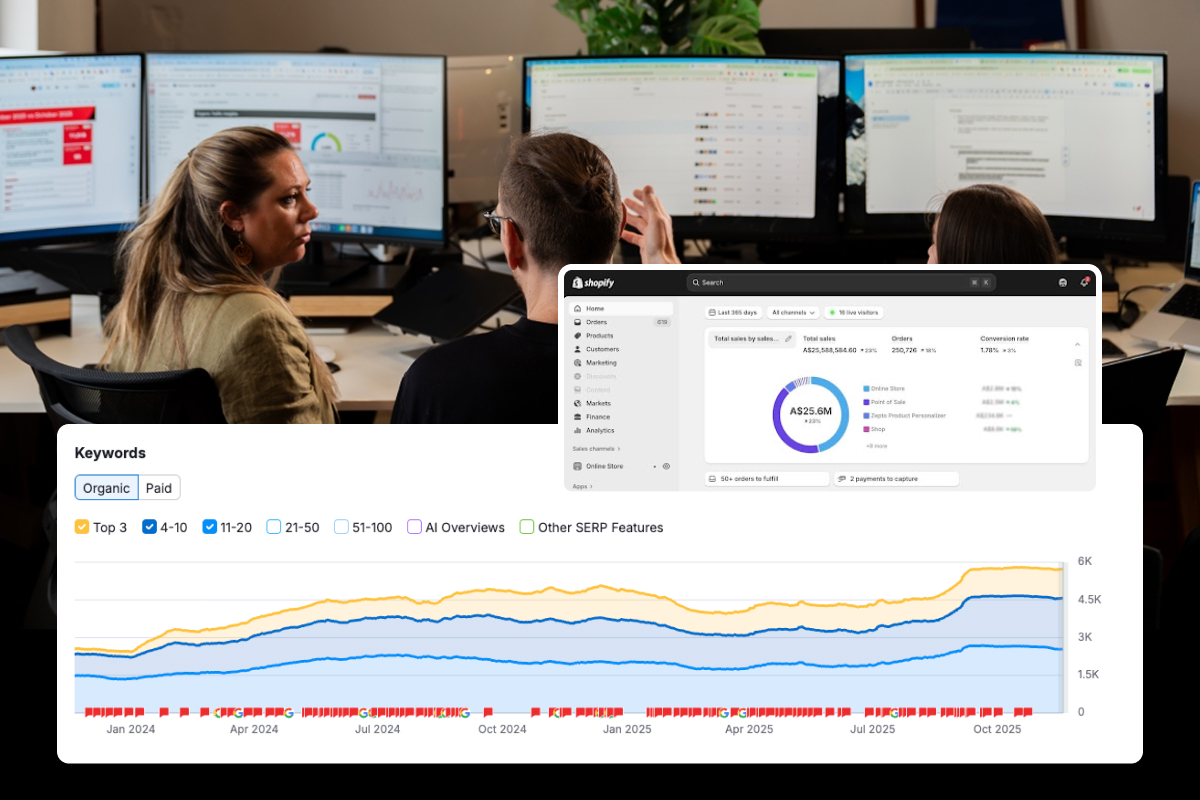
Working with an Australian DTC e-commerce client through a softening trading cycle, we held investment steady across paid social campaigns and Google Ads management while several of their competitors paused or pulled back. The result over a 36-month stretch of consistent activity: cost per new customer fell 35%, return on ad spend climbed to 9.1x, and the brand has now posted three full years of compounding sales growth. None of that happens if you disappear from the market for a quarter while you wait for conditions to improve.
The consumer is different than they were 12 months ago
Here’s the part most “spend through the downturn” arguments miss. The case for investing now isn’t just that your competitors are retreating. It’s that the consumer themselves has shifted, and the shift favours brands that show up.
Jarden’s data on the evolved Australian consumer is striking. Today’s shopper is more promiscuous, less loyal, cross-shopping more aggressively than at any point in recent memory. They are intensely value-focused, weighing price, range, service and quality before they commit. They research more, starting almost every purchase journey online. And they are flipping between “pull mode” and “push mode” depending on what brands actually do to earn their attention.
What that means in practice: brand loyalty is being actively re-evaluated, in real time, across every category. When a household decides to switch supermarket, switch insurer, switch energy provider, switch coffee, they are making that decision now. The brand they choose is the brand whose message reached them, made sense, and felt relevant during the months they were actively reconsidering. If you are not visible during a re-evaluation moment, you are not on the shortlist. It’s that simple.
This is why cutting marketing spend in 2026 is more expensive than cutting it would have been in 2023. Loyalty was sticky then. It is not sticky now.
Push spend… but push it with control
None of this is an argument for spraying budget around. “Don’t pull back” is not the same as “spend more on the same things you were already doing.” The right play in this environment is deliberate, controlled, and weighted differently to a growth-cycle plan. Three principles are worth holding to, and they should sit at the centre of any performance marketing strategy running through the next two quarters.
1. Weight investment toward top-of-funnel awareness
This is the moment to grow mental availability and category presence, not the moment to chase every available conversion. When competitors retreat from brand-building (and they will, because brand spend is the easiest line to cut), share of voice gets cheaper. Every dollar of awareness investment goes further than it did 12 months ago, and the share-of-voice gains you build now compound into share-of-market gains over the next two to three years. A well-structured Meta Ads strategy running broad reach plays alongside high-intent conversion campaigns is one of the most cost-efficient ways to do this for most categories in 2026.
2. Be ruthless about controlled outcomes
“Control” means defining what success looks like before the spend goes out the door. Are you trying to expand reach into a new audience segment? Lift unaided awareness in your core category? Build a remarketing pool you can convert when conditions improve? Pick the outcome, instrument it, and hold the campaign to it weekly. Vanity reach is not a strategy. Reach against a defined growth audience, measured against a real business KPI, absolutely is.
3. Compound creative advantage
Nielsen Catalina’s research is unambiguous: creative quality drives 56% of a digital ad’s sales impact, and advertisers running five or more distinct creative concepts see 2-3x lower cost per acquisition. The brands that win the next 18 months will be the ones that diversified their creative inventory while the market was soft testing angles, formats and audience hooks now, so they have a battle-tested creative library ready when their competitors are scrambling to ramp back up.
The window is short, and it is open right now
It is worth being plain about this: the brands that come out of the next 12 to 18 months as category leaders are being decided in the next two quarters. The decisions are being made in boardrooms across Australia right now, by owners and CMOs choosing between protecting margin in the short term and protecting market position in the longer term.
The owners who treat this as a down period will, mostly, survive. They will also wake up in 2028 wondering why their share is half what it used to be and why the brand that took it from them seemed to come out of nowhere.
The owners who treat this as a window will spend the same period planting the flag.
This isn’t a call to gamble. It’s a call to be deliberate and to recognise that the cost of staying in market is cheaper than it has been in years, the consumer is more open to re-evaluation than they have been in a decade, and the businesses willing to keep their hand up while the room goes quiet are the ones that will be heard.
Now is not the time to go dark. Now is the time to go deliberate.
Frequently asked questions
Should I cut my marketing budget during an economic downturn?
Cutting marketing spend in a downturn produces an immediate saving on the P&L but creates a much larger, delayed cost: lost mental availability, lost share of voice, and a two-to-three-year recovery period to rebuild the awareness you let drain away. Decades of marketing-effectiveness research from John Philip Jones through to the IPA and Analytic Partners that show that brands which maintained or grew investment during recessions consistently emerged with more market share than those that pulled back. The smarter move is usually to hold or modestly increase spend, while shifting the weighting toward brand-building.
How much of my budget should go to top-of-funnel awareness in a slowdown?
It depends on category, brand maturity and what your competitors are doing, but a useful starting point is the long-run 60:40 brand-to-activation ratio shown in IPA effectiveness data. In a downturn when competitors are pulling back on brand spend and consumer loyalty is actively being re-evaluated, the case for tilting further toward awareness gets stronger. The goal isn’t vanity reach; it’s capturing share of voice while it’s cheaper than usual, then converting that into share of market over the next 12–24 months.
Which channels work best for brand-building in 2026?
For most Australian brands, broad-reach video and feed placements across Meta technologies (Facebook, Instagram, Reels) and YouTube remain the most cost-efficient awareness channels, especially when paired with a diversified creative strategy. The right answer depends on where your customers actually spend their attention, but a well-built Meta Ads strategy, layered with high-intent Google Ads campaigns to capture the resulting demand, will cover the majority of upper- and lower-funnel needs for most consumer and B2B categories.