Website Migrations Without Losing Traffic or Rankings
Website & SEO Migration Services
Migrating your website can be complex, but DNM Digital makes it simple. We handle every step, from platform and domain changes to full redesigns, with redirect mapping, staging tests and post-launch monitoring that protect your traffic, functionality and performance.
- Launches tested on staging first, so your site stays live
- End-to-end SEO, analytics, and performance checks
- Smooth platform, domain, and redesign migrations





















Already Migrated and Lost Your Rankings?
If your site went live without redirects, content mapping or a crawl check, and your traffic has dropped, you’re not stuck with it. Our website migration recovery service diagnoses exactly what broke and restores it in order: redirects and technical signals first, then your Google rankings, then your AI search visibility through GEO recovery. Whether the rebuild was traditional or AI-built, the sooner it’s fixed, the more equity you get back.
Website Migrations Done Right
Website Migrations We Specialise In
Every website migration comes with its own challenges. If you’re moving domains, redesigning your site, or changing platforms, DNM Digital handles the entire process. We specialise in:
- Domain Migrations: Move to a new domain without losing traffic, rankings, or SEO equity.
- CMS & Platform Migrations: Switch platforms like WordPress, Shopify, or custom systems smoothly, with every URL mapped and redirected.
- Website Redesigns: Update your site’s look and structure while keeping URLs, SEO, and user experience intact.
- eCommerce Migrations: Safely move online stores, product pages, and checkout systems without losing sales.
- International Migrations: Implement multi-language or multi-region setups with hreflang handled correctly.
- URL Structure Changes: Restructure URLs or navigation while protecting SEO and search visibility.

The Risks of a Poorly Managed Migration
Why Website Migrations Fail
Website migrations are delicate projects. Even small mistakes can have a big impact on traffic, rankings, and user experience. Many businesses underestimate the complexity, treating migrations like a simple development task instead of a carefully planned SEO-led process.
When URLs aren’t correctly mapped or redirected, visitors may land on broken pages or error screens. This can result in immediate drops in organic traffic and lost leads or sales.
Search engines need time to understand your new site. If metadata, internal linking, or URL structures aren’t properly handled, previously high-ranking pages can fall in search results, sometimes permanently.
Improper or missing 301 redirects create 404 errors, which frustrate users and signal to search engines that pages are gone. This can erode domain authority and SEO equity built over years.
A poorly executed migration can leave pages unindexed or removed from search results entirely. Crawlers may fail to find new pages if sitemaps, robots.txt, or canonical tags are misconfigured.
Titles, descriptions, headings, and structured data can be lost during platform or redesign migrations. This not only impacts SEO but also reduces click-through rates in search results.
From a real migration
The Redirect Map Does Most of the Work
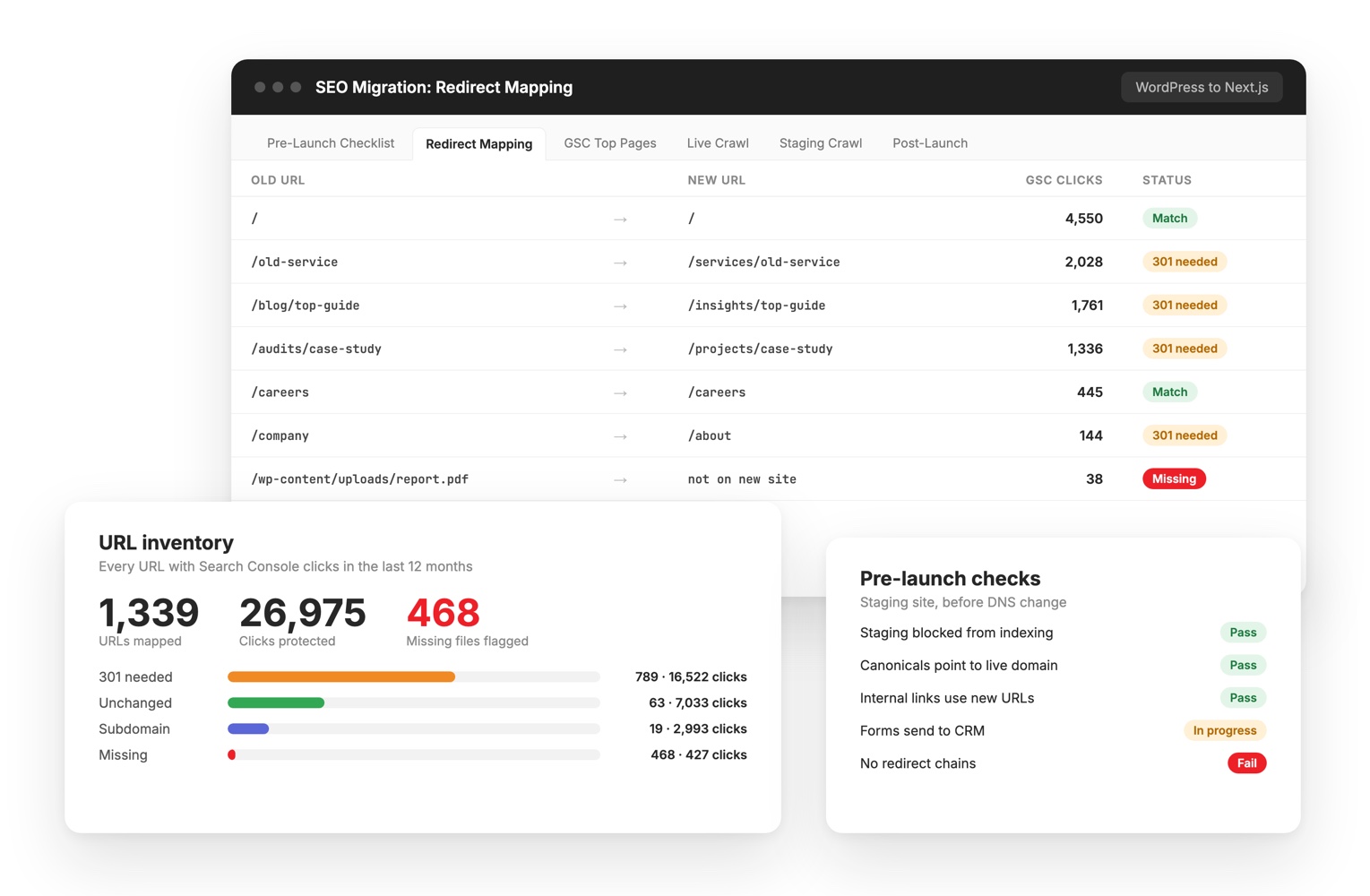
A migration lives or dies on the redirect map. On a recent move from WordPress to Next.js, we mapped 1,339 URLs that had Search Console clicks in the past 12 months. 789 needed a 301 redirect and between them carried 16,522 clicks. Another 63 stayed the same. We also flagged 468 old PDF files that did not exist on the new site, so the developer could host or redirect them before launch instead of finding out from a wall of 404s afterwards.
The pre-launch checks caught three more problems while they were still cheap to fix:
- An old redirect chain that ended on a page that no longer existed
- A contact form that had not been connected to the CRM on the new platform
- Two pairs of duplicate pages that each needed a single canonical version
How we run every migration
The Rules We Don't Bend
Staging has to be final before we start
Fonts and colours can still change. Pages, content and URLs can't, or the redirect map is out of date before it's finished.
Two weeks minimum before go-live
That's the shortest time we need from a final staging site to map, check and fix everything properly.
Launch Monday or Tuesday, never Friday
So the team is on hand to fix anything that breaks, instead of it sitting broken all weekend.
Lower your DNS TTL before launch
Dropping it 24 to 48 hours beforehand means the switch-over reaches everyone quickly.
Freeze metadata for two to three weeks
Changing URLs and titles at the same time makes it harder for Google to match old pages to new ones. We improve them once things settle.
No homepage dumping, no chains
Every old URL goes straight to its closest match with a server-side 301. Google treats mass homepage redirects as soft 404s.
After launch
What Happens After Go-Live
Some ranking movement while Google recrawls your new URLs. We check indexing and 404s daily in the first week.
Rankings settle and recovery starts. We compare keywords and traffic against the pre-migration benchmark.
A well-run migration should be back to its benchmark or better. If it isn't, we work through redirects, backlinks, content and rendering until it is.
Discover What’s Holding Your Website Back
Want a Migration Audit Worth $2000?
Get a detailed performance review of your website, completely free. We’ll identify missed opportunities and strategies to help you build a website migration plan.
"*" indicates required fields
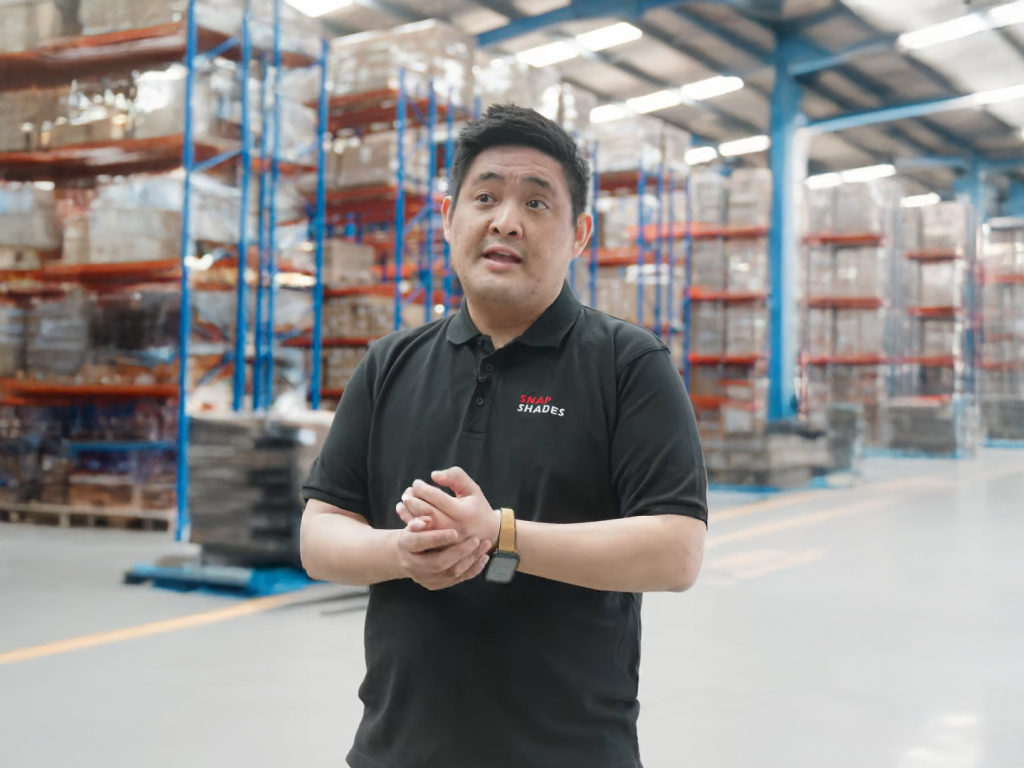
CLIENT CASE STUDY
SNAP SHADES
100%
Full Funnel Strategy$1M+
Ad spend Monthly225%
Increase in 1st Page Keywords
Got Questions About Website Migrations?
Frequently Asked Questions
The timeline depends on the size and complexity of your site. Small sites may take a few days, while large or eCommerce migrations can take several weeks, including testing and post-launch monitoring.
Some short-term movement is normal while Google recrawls your new URLs, and it usually settles within a few weeks. Our SEO-led process (redirect mapping, metadata transfer, tracking checks and post-launch monitoring) keeps that dip small and short, and we fix anything that does not recover.
Yes. We use staging environments and carefully timed transitions to ensure your site remains live throughout the migration.
Absolutely. We migrate Shopify, Magento, and other online stores, preserving product data, URLs, and checkout functionality to prevent lost sales.
As early as possible, and at least two weeks before launch with a finished staging site. The earlier we see the new URL structure, the fewer redirects and fixes are needed.
We recommend waiting two to three weeks after launch. Changing URLs, titles and content all at once makes it hard for Google, and for us, to tell what caused any movement.
Google Search Console, GA4, the staging site and a contact on your development team. For a domain change we also need whoever manages your DNS.
We create a detailed redirect map to ensure all old URLs point to the correct new pages, protecting SEO and user experience.
Yes. We handle hreflang, multi-country setups, and ensure search engines index all versions correctly.
Yes. We collaborate with your team to coordinate server access, DNS changes, and any technical requirements needed for a smooth migration.
We monitor indexing, crawl errors, and traffic after launch, fixing any issues and optimising where needed to make sure your site performs as it should.
As its own project, because it is one. If you are already on an SEO retainer, we can dedicate a month of the retainer to the migration instead.
Yes. We compare your old URLs against the new site, rebuild the missing redirects and fix the technical issues first, then work on recovering rankings. See the migration recovery section near the top of this page.
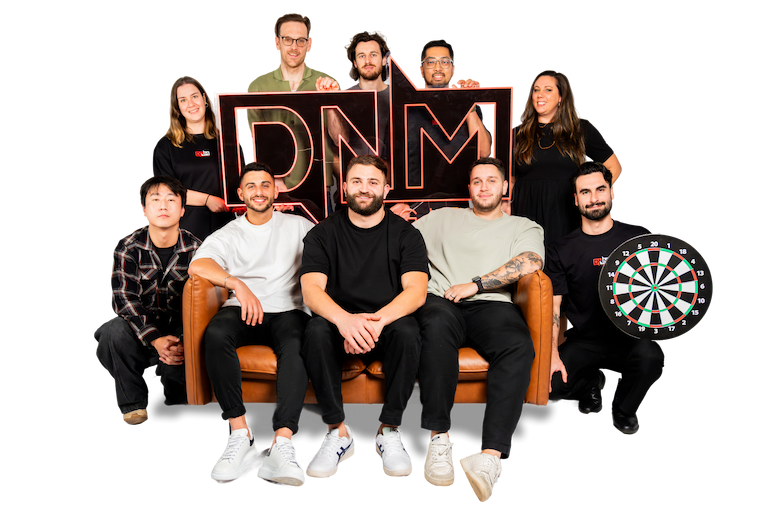
Ready to hit the mark? Let’s get started!
Ready to take your business to the next level? Let DNM Digital’s expert team create a tailored strategy that drives results. Contact us today and start seeing real, measurable growth!
